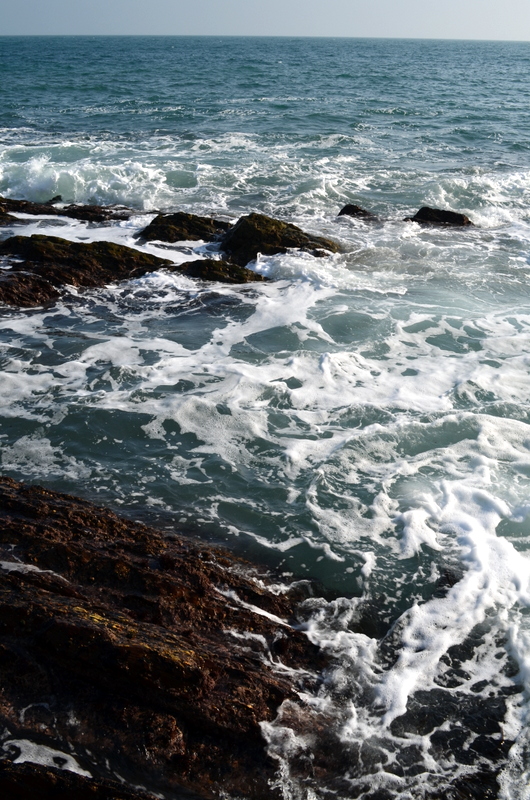
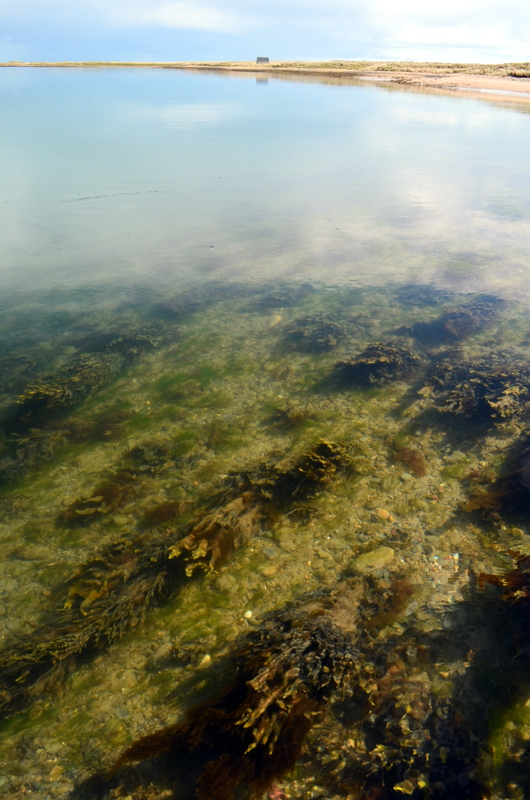
Having spent a few pleasant days working this week its noticeably cool but very nice out there. Winds have blown consistently from a Northerly direction since late March and after a little exceptional weather in the latter days of the month during which we caught some fish things are ‘Spring’ slow here in Wexford.
Water conditions are crystal clear with only a few indications of shrimp, sandeel and immature flounder showing but its still very early, with strong cold air running over cold water it never makes things easy.
I never expect too much at this time of year from a bass perspective, and its probably not until the next set of Springs that I would anticipate to catch some numbers of bass with confidence and even then its always touch and go. See indications here
But its great to be out and with a few customers who are willing to try for an early bass or even a possible seat trout or mullet I had a great week of trying some new gear and locations. I continue to experimental fly fish as much as possible and I am still modifying our seatrout bass and mullet range of flies. I had some interesting fishing on Sunday last watching fish track the fly inch by inch for maybe 10 feet but not eating – next week is the last of my semester so school’s out for Summer at last!
Interesting possibility on Monday……but in reality its still very difficult out there for your unit of effort.
If you would like a relaxed estuary fishing/workshop Spring day then please take a look here
Angling tourism can be developed through: provision and presentation of information using state of the art technology; increased public access to angling; development of a broader outdoor tourism portfolio; the clustering of businesses and co-operative competition; and community land ownership
Angling tourism needs to be developed sustainably, maintaining a balance between ‘development’ and environmental and social management factors.
From fishing for Answers the final report.
Fishing for Answers summarises the key findings from three years of research on the benefits angling delivers for people and their communities. It focuses on angling’s contribution to six key areas: sports participation; health and well-being; the natural environment; community development; tourism and rural communities; and young people.
Section 5: Angling tourism and Rural Areas
The entire Document can be found here to download
We asked anglers in our Assynt Anglers Survey in 2010 to identify the most important things about angling in Assynt. The results are presented in the bar chart below. Although the catch-related aspects of the angling experience – most notably the quality of fish stocks – perhaps inevitably received a large number of 1st place rankings, the remoteness, fishing mountain lochs, being able to fish without seeing others and the scenery in which people go fishing scored highest overall. These results suggest that anglers who visit Assynt value the social isolation and the quality of the landscape at least as much as they do the actual fishing.
In a cool North Easterly and bright conditions Jerome and I spent a pleasant afternoon getting a sense of the requirements. There are times when I’m reminded that its the most difficult and challenging way to catch fish, the casting the waves the water the basket the line the leader the retrieve the wind the fly the environment the you…
It takes time.
…Our wallets are therefore powerful weapons in the fight to create a more sustainable future. The IWT does not advocate an end to fishing. We believe that fish is an essential part of our diet, culture, society and economy. It is vital for the survival of coastal communities all around our island. However, the type of fish we eat, particularly by knowing where and how our fish has been caught, can send a strong signal to decision makers that change is urgently needed. Having said that, making choices at the fish counter is not easy and so much more needs to be done to inform the public about the impacts of these choices. The IWT is therefore delighted to publish Ireland’s first consumer’s guide to sustainable seafood. Because the information is not always clear cut we have developed a traffic light system. Green, Amber and Red.
AMBER – this may be OK to eat but we don’t know enough to be sure. Little is known about the state of the stock, the way it is fished causes damage to the marine ecosystem or there is enough evidence to suggests that stocks are declining.
Bass are currently classed in this system as Amber
Taken from the Irish Wildlife Trust – Article Sustainable Seas
____________________________________________________________________________
One of the many questions from the Environmental Pillar Submission made recently caught my attention. The entire .pdf can be located here
In Briefing Document II each marine sectors is presented in turn with no conceivable attempt at assessing synergistic or conflicting interests and needs. In order to achieve integration the plan will have to be discussed by all stakeholders in inclusive manner, while addressing environmental, resource
and financial restrictions. Such an approach would help to reduce duplication, improving efficiency across sectors, and planning.
I can agree with this provided each marine sector and all stakeholders are presented, yet there is scant mention of angling or angling related activities in the midst of any of this!
There’s something pleasant about being out on the water
and when that opportunity is combined with fishing then its a real pleasure. The small boat has added another dimension to the angling for me and I’m happy to spend time simply exploring and mapping whilst I can.
Adding the boat does create launch and recovery time but then there’s the added dynamic of been able to go where and when I like. Combined with a picnic of homemade food a Kelly kettle a little sunshine and the sound of skylarks what more is needed for a complete day.
Fly casting for bass on a southern facing shoreline is always going to present problems to all but the most accomplished of casters. Orienting ourselves with the wind at our backs is now on option to take some of the difficulty out of the fishing from time to time.
So I look forward to a little more manoeuvrability and different options for my customers and their fishing during the summer and into the autumn. I’m reminded that I don’t ever have to go far to catch fish.
For an early season estuary foray please mail me at sportfishing@eircom.net or call at 086 3444557
Bendy rods for 2012 – Jim

Its distinctive simplicity and clarity of approach in a ‘quiet’ way still influences me today. I got this e-mail from Ray yesterday
________________________________________________
Greetings Jim, I’ve occasionally come across your site and have noticed some interest in some of my patterns and book,
I just began a new website that I think those “across the pond” on your site may find interesting.
http://raysfly.wordpress.com/
regards
Ray Bondorew
Author of “Stripers and Streamers” r
‘Where again Jim’? He asked quietly, he was crouching slightly, bent forward at the waist
‘Just there’ I said, pointing, ’about a metre in front and to the right of the black rock’ I said
We were side by side, close, standing in the warm clear water to our bellies. A tidal rip ran 30 metres in front of us right to left surging through and over a rocky reef. The early morning sunlight fell on the calm warm water, broken into a fractured world of myriad patterns on the clean sand at our feet. Sea lettuce, crabs and little shrimps wandered past occasionally in the tide, terns hovered overhead.
He made the cast perfectly, the line unrolled and the fly landed just in the right position, holding the rod slightly high for a moment keeping the line above the grip of the flowing tide.
‘Just wait a second’ I said,
Then a welcome gentle breeze helped a brilliant small up tide mend in the line. My heart was racing a little, a second was an eternity.
I whispered to him to drop the rod tip and the line fell to the water like a long blue strand of weed. Pinching the line with a finger and thumb he began to make short strips. The gurgler spat and slid across the water. Retrieving very little but maintaining contact and control, the fly immediately working, a straight down tide run picking up speed as it passed the black rock, head pointing away from us, bobbing and searching, lost in the grip of the current. Curving towards us now and beginning to cross the narrow channel I knew we had only seconds for the opportunity in this lie– it had to be perfect.
It wasn’t perfect but it was good enough, ‘it’s gunna happen’ I whispered. He kept looking at the fly, stripping, focused, and still crouched. Only moments left, half a metre, and then suddenly there was that unique sound of a big fish hitting a surface fly, an explosion of white water. A sudden moment of fear, of shock and surprise, line stripped reel screamed and then there was silence. I heard a tern.
The fish wasn’t on.
‘Stop for one second’ I said,’ throw some slack’
‘Now short strip it, quick’
And then suddenly the aggression the strength and the ability of the fish to manoeuvre in fast moving water was revealed to us as it turned and hit the fly again, took and swam downtide, its powerful tail driving it, its head shaking furiously from side to side. Stripping line against the drag in the strong current, the rod held low fighting the butt, rod tip dipping rising, dipping rising. The fish stopped, the rod lifted suddenly and then bent again as the fish took another fifteen yards heading towards a rocky hell.
A little less than ten seconds had passed since the angler had made the cast, and in the midst of this experience he turned and smiled at me, happy.
Surely this was the best way to catch these fish.


You must be logged in to post a comment.