Leave no trace in a bass guiding service.
I have spent a long time learning how to catch fish, particularly bass. I have also invested time in trying to return them as effectively as possible, at times I know this is cannot always be the case or always possible but its a part of the daily process of guiding to try to ensure good fish ‘returns’.
Currently I’m looking even further at how I might improve other aspects and impacts the business may be having in the coastal environment. I am trying to learn how best to minimise these impacts and indeed pass that knowledge on to other anglers who may be interested.
In a world subjected to ever increasing recreational pressure every little bit of work and effort helps. I have always felt that no matter what else may be happening and who may be responsible I believe its important to try to do something better, to be seen to be trying, to have the ability to say this is what I am doing to help things – At the heart of Leave No Trace are the 7 principles for reducing the damage caused by outdoor activities.
One of those outdoor activities is of course angling and angling encapsulates a lot of the topics below. These are the principles that I attempt to adhere to as much as possible when either guiding or personally fishing. Make none and Leave none – they are yours to interpret and apply to your fishing when you can. Make it difficult for others to see or hear you and Leave No Trace of your presence
I have also included the nine associated behaviours as issued by the Fly Fishing Federations’ Code of Angling Ethics.
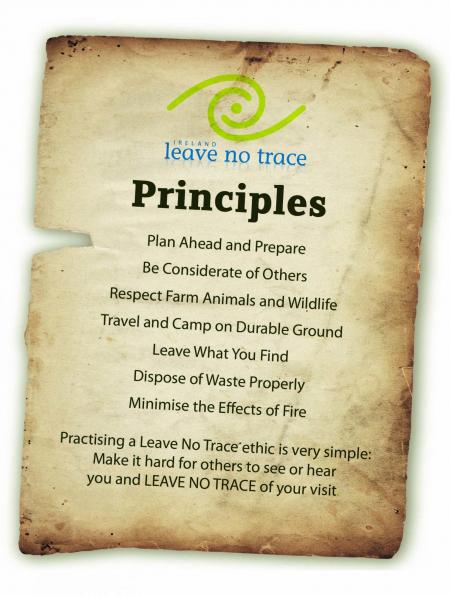
The 7 principles of Leave no Trace
1
Plan Ahead and Prepare
- Before you go check, where possible, if access is allowed and your activity is permitted in the area you wish to visit.
- Respect any signs, regulations, policies and special concerns for the area that you wish to visit. Permits may sometimes be needed for activities on public lands.
- Where possible travel by public transport or share cars; consider the availability of parking.
- Ensure you have the skills and equipment needed for your activity and to cope with emergencies that could arise.
- Check the weather forecast and always be prepared for changing weather conditions.
- For environmental and safety reasons, and to minimise your impact on other users, keep group numbers small; split larger parties into smaller groups.
2
Be Considerate of Others
- Respect the people who live and work in the countryside.
- Park appropriately – avoid blocking gateways, forest entrances or narrow roads. Remember that farm machinery, local residents and the emergency services may need access at all times.
- Take care not to damage property, especially walls, fences and crops.
- Respect other visitors and protect the quality of their experience.
- Let nature’s sounds prevail. Keep noise to a minimum.
3
Respect Farm Animals and Wildlife
- Dogs should be kept under close control and should only be brought onto hills or farmland with the landowner’s permission. Some public areas stipulate that dogs must be kept on a lead at all times, please adhere to local guidelines.
- Observe wild animals and birds from a distance. Avoid disturbing them, particularly at sensitive times: mating, nesting and raising young (mostly between spring and early summer).
- Keep wildlife wild, don’t feed wild animals or birds – our foods damage their health and leave them vulnerable to predators.
- Farm animals are not pets; remain at a safe distance.
4
Travel and Camp on Durable Ground
Durable ground includes established tracks and campsites, rock, gravel, dry grasses or snow.
In popular areas:
- Concentrate use on existing tracks and campsites.
- To avoid further erosion, travel in single file in the middle of the track even when wet or muddy.
In more remote areas:
- Disperse use to prevent the creation of new tracks and campsites.
- Avoid places where impacts are just beginning to show.
If camping:
- Protect water quality by camping at least 30m from lakes and streams.
- Keep campsites small and discreet.
- Aim to leave your campsite as you found it, or better.
5
Leave What You Find
- Respect property. For example, farming or forestry machinery, fences, stone walls etc. Leave gates as you find them (open or closed).
- Preserve the past: examine – without damaging – archaeological structures, old walls and heritage artefacts e.g. holy wells, mine workings, monuments.
- Conserve the present: leave rocks, flowers, plants, animals and all natural habitats as you find them. Fallen trees are a valuable wildlife habitat; do not remove or use for firewood.
- Avoid introducing non-native plants and animals e.g. zebra mussels in rivers and lakes.
- Do not build rock cairns, structures or shelters
6
Dispose of Waste Properly
- “If You Bring It In, Take It Out” – take home all litter and leftover food (including tea bags, fruit peels and other biodegradable foods).
- To dispose of solid human waste, dig a hole 15-20cms deep and at least 30m from water, campsites and tracks. Cover and disguise the hole when finished.
- Bring home toilet paper and hygiene products.
- Wash yourself or your dishes 30m away from streams or lakes and if necessary use small amounts of biodegradable soap. Bring home any solids and scatter strained dishwater.
- For more information on sanitation in the outdoors read the “Where to go in the outdoors” leaflet
7
Minimise the Effects of Fire
- Fires can cause lasting impacts and be devastating to forests, natural habitats and farmland. Therefore when camping use a lightweight stove for cooking.
- Where fires are permitted: Use established fire rings, barbecues or create a mound fire.
- Keep fires small. Only use sticks from the ground that can be broken by hand. Do not use growing vegetation for use as firewood.
- Avoid burning plastics or other substances: which emit toxic fumes.
- Burn all fires to ash, put out fires completely, and then scatter cool ashes.
_______________________________________________________________


Leave a reply to Saltwater Fly Fishing Workshop Oct 2016 | Jim Hendrick Cancel reply