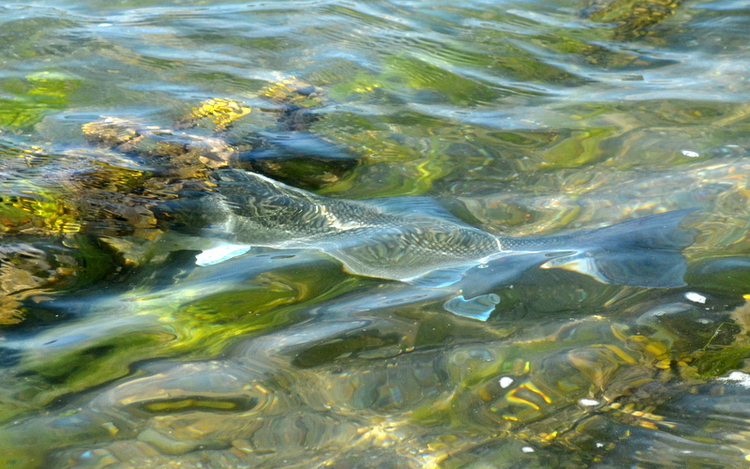
Slow hand

For a long time, the theory of fly-fishing in the salt was that by casting far, anglers would be able to reach the fish. A side benefit came in the form of prospecting. If there wasn’t a pod of fish close to the horizon, a long cast would cover more water and therefore give an angler a greater likelihood of hooking up.

Interesting article on slowing down here

image

About the fish

Although bass are widespread along the western seaboard of Europe ((Wheeler), 1969)they are recognised to be a species of warmer waters, typically a southern European, Northern African fish. The Wexford fishery is situated in the zone of greatest abundance of bass on the east Irish coast and thus is as close as possible to the supposed centre for the species in the Celtic Sea (Williams, 1974)

From – (Fahy, 1981)

Mean temperatures were above normal everywhere with largest differences above normal in the west and southwest. Stations in the southwest reported their warmest January since 2002 (10 years), while stations in the west and midlands reported their warmest January since 2007 (5 years). Maximum air temperatures recorded during January were above normal, with most recorded on the 3rd and with the month’s highest temperature of 13.1°C recorded at Shannon Airport on this date.

Minimum air temperatures were also above normal for the time of year, with Sherkin Island recording a January minimum temperature of 2.5°C, the warmest at the site since 1990 (22 years). Other stations in the south and southwest reported their warmest minimum temperatures in 10 to 19 years, while most remaining stations across the country reported their warmest in at least five years.

Warmer than normal minimums led to stations reporting a below average number of days with air frost, with between zero and four days recorded. Days with ground frost were also below average due to above average grass minimum temperatures. Belmullet reported a minimum grass temperature of -2.2°C, its highest grass minimum since 1983 (29 years) and reported only four days with ground frost, much lower than its January average of 11 days.

Rainfall was above average almost everywhere, except for stations in the south. Roche’s Point and Johnstown Castle received 61% and 63% of their long-term average rainfall, respectively, with Johnstown Castle recording its driest January since 2007 (5 years).

Sunshine totals were below normal almost everywhere with percentage of normals ranging from 50% at Valentia Observatory to 112% at Dublin Airport. Below normal sunshine stations reported it was the dullest January in five to 19 years, with Valentia reporting the least sunshine this month, with 21.9 hours and its dullest January since 1983 (29 years).

those days, not far away…..


AGAINST THE TIDE from Matt Dunkinson Photography on Vimeo.

There’s something about fly fishing in the sea, maybe its something about fly fishing or maybe its just plain bass fishing. Combining fly fishing with the pursuit of bass has done it for me. Picking up a fly rod and a few flies and going to the sea to try to catch them, well the fish already have the advantage before I even get out the door. That’s what I like about it, they have the upper hand, the high ground, they have a chance.

bass fishing on the fly

There’s nothing ‘superior’ about the method – a good friend calls it  ‘lawww deee dawww’ bass fishing, I like that! In the end like everything in bass fishing its down to you. The technique, the method, the when and the where. Fly fishing for bass requires more from you as an angler than any other method, no big deal, you either like it or you don’t.

The requirements for good fly fishing are exactly the same for lure fishing – good casting, good presentation, right choice of ‘bait’, right choice of gear, location decisions, timing, presence, awareness, watercraft……….

So where’s the more? Maybe in fact its more often a less…….

A little about the fish

Although bass are widespread along the western seaboard of Europe ((Wheeler), 1969) they are recognised to be a species of warmer waters, typically a southern European, Northern African fish. The Wexford fishery is situated in the zone of greatest abundance of bass on the east Irish coast and thus is as close as possible to the supposed centre for the species in the Celtic Sea (Williams, 1974)

From – (Fahy, 1981)

The sea bass is a sub-tropical species at the northern limits of its range in the British Isles. It is more common along the southern coasts of these islands and forms winter aggregations in the Celtic sea from which it disperses around the coast of Britain and Ireland as the water warms in spring and summer. Bass stocks are maintained by variable recruitments which also appear to be temperature related and probably regulated; a succession of good recruitments and improved growth contributing to a build-up of stocks to bring about a cyclical abundance. (Fahy, 2000)

There is no doubt that as we continue to catch bass all along our coasts today and while frequent exceptions occur as regards numbers, timings and even locations, lots of ‘patterns’ remain the same whilst some may be changing. Global warming and its effects will surely play a major role on the movements and populations of the fish in the current and future years.

Devauchelle (Devauchelle, 1984) suggested that gonad maturation and spawning were influenced by temperature; Kelley (1988) believed that exceptionally cold weather was detrimental to bass during their first sea winter. Perhaps the greatest influence that we are experiencing at this time is the possibility of rapidly changing and fluctuating sea temperatures. Pawson (1992) identified critical seasonal temperature periods in the annual biological cycle of bass

  • November to the following March when the gonads develop
  • March to May when spawning occurs and
  • May to November when growth takes place

Temperature conditions on the Irish coast are critical to the performance of bass stocks and as Pawson demonstrated in his paper the seasonal inshore waters of the English Channel had undergone cycles of cooling and warming and cooling during the decade 1980-1990. Data collected at Malin head and expressed in similar fashion over the same period demonstrates similar patterns in temperature fluctaution as experienced in the English Channel.

Pawson demonstrated the correlations between the abundance of juvenile bass in the English Channel and the temperature deviations determined.

Kennedy and Fitzmaurice (Fitzmaurice, 1972) found that it was possible to identify years of both good and poor growth in bass.  They also identified that good growth years were successful brood years. Further analysis of the data led to the conclusion that bass in Irish waters conform to a single growth curve which is temporarily altered by either good or poor growing years.

On the further south eastern and southern coasts from (Fitzmaurice, 1972) ‘Adult bass are present in estuaries and along the shore as a rule until late November or even December. Bass have been caught on hand lines in Youghal bay in fine weather in January and the salmon netsmen take occasional bass in the nets in Youghal bay in February and March. In January 1953 a trawler took a large catch of adult bass about 1 mile from Rosslare Harbour and 3.5 miles from Wexford harbour. These bass were caught in 3 fm’s over clean sand in an area of extensive sandbanks. Some bass therefore do not go very far from shore or into deeper water during the winter.’

Kennedy and Fitzmaurice conclude ‘Sea temperatures are probably the main factor influencing the autumn, winter and spring movements of bass.’

With an extremely mild winter of 2011/12 experienced so far and an extremely cold winter of 2010/11 fish will continue to move and perform according to the influences as they have done in the past.


found

saltwater fly fishing ireland


Going Dutch for bass

The Dutch are adopting a similar protection model to Ireland
Henk Bleker, State Secretary (Economic Affairs, Agriculture and Innovation) intends to work with both sport and commercial fishing on the bass protection plan Sportvisserij Nederland suggested. This is the commitment he made yesterday in the House of Representatives in reply to the questions asked by Lutz Jacobi (PvdA) during the meeting from the Agriculture and Fisheries Council.
At the meeting, Member of Parliament Jacobi pointed everybody on the plan Sportvisserij Nederland submitted. This plan is related to the Irish regulation model….In the Dutch situation Sportvisserij Netherlands opts for a variation on the Irish sea bass plan.

See more details here

image

Chill out…

image

image

image